

The Uttarakhand Public Service Commission (UKPSC) released the official notification for UKPSC Lecturer Recruitment 2025 on December 30, 2025, announcing 808 vacancies for Lecturers (Group-C) in Government Inter Colleges.
For Physics subject, there are 80 posts (73 in General Branch and 7 in Female Branch). This is an excellent opportunity for M.Sc Physics graduates with B.Ed or equivalent to secure a government teaching job.
If you are preparing for this exam, start with the complete recruitment overview in our detailed guide: UKPSC Lecturer Physics Recruitment 2025: 80 Vacancies, Eligibility, Salary & Application Process.
The selection is based solely on a written examination (no interview). Mastering the UKPSC Lecturer Physics Syllabus 2025 is crucial for success. Below is the most detailed topic-wise syllabus based on the official notification, along with exam pattern and preparation tips.
UKPSC Lecturer Physics Exam Pattern 2025
- Mode: Offline Objective Type (MCQs)
- Papers: Two Papers (Paper I & Paper II)
- Questions per Paper: 150
- Marks per Paper: 150 (1 mark per question)
- Duration per Paper: 3 Hours
- Total Marks: 300
- Negative Marking: 1/4 mark deducted for each wrong answer
- Minimum Qualifying Marks: 45% (General), 40% (OBC/EWS), 35% (SC/ST)
| Paper | Focus Areas | Questions | Marks | Duration |
|---|---|---|---|---|
| Paper I | Classical Mechanics, Electricity, Magnetism, Waves, Mathematical Physics | 150 | 150 | 3 Hours |
| Paper II | Modern Physics, Optics, Thermodynamics, Electronics, Condensed Matter | 150 | 150 | 3 Hours |
| Total | 300 | 300 | 6 Hours |
Detailed UKPSC Lecturer Physics Syllabus 2025
Paper I: Classical Mechanics, Electromagnetism & Mathematical Methods
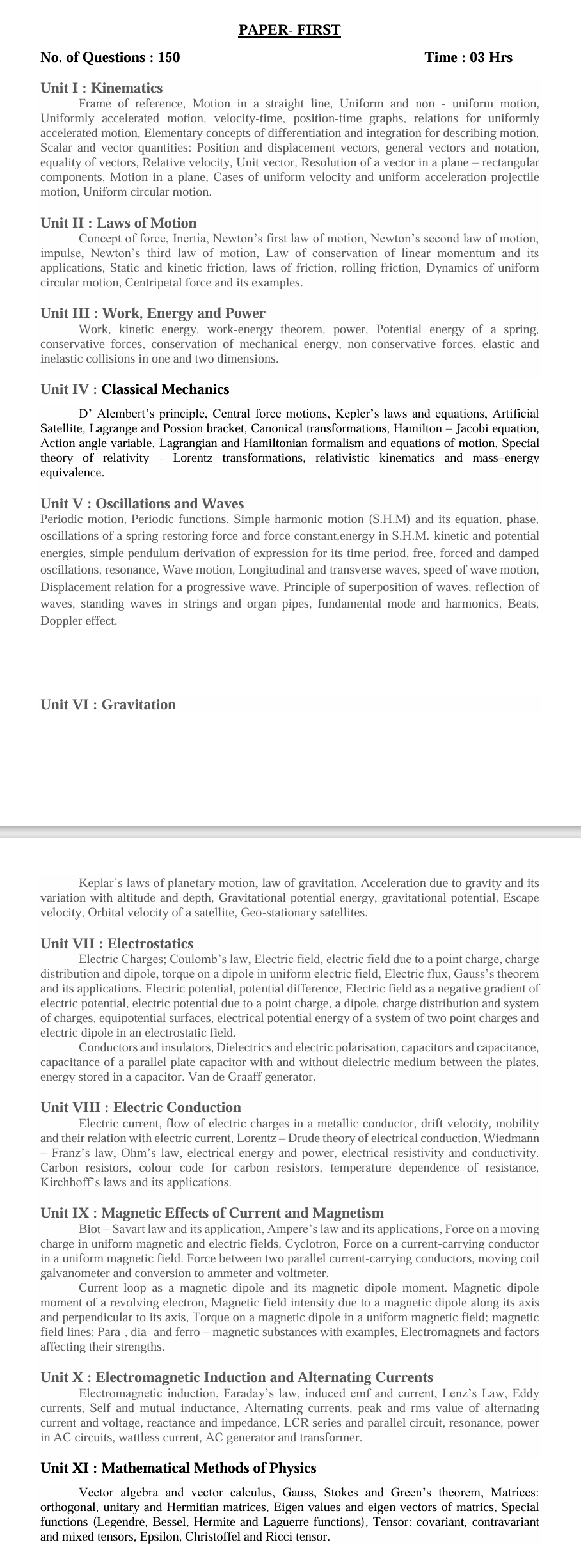
- Kinematics
Frame of reference, motion in a straight line (position, velocity, acceleration), scalar and vector quantities, relative velocity, unit vectors, motion in a plane, projectile motion, uniform circular motion, tangential and radial acceleration. - Laws of Motion
Concept of force and inertia, Newton’s three laws of motion with applications, impulse and momentum, law of conservation of linear momentum and its applications, static and kinetic friction (laws, rolling friction), dynamics of uniform circular motion, centripetal and centrifugal forces. - Work, Energy, and Power
Work done by constant/variable force, work-energy theorem, kinetic and potential energy, conservative and non-conservative forces, power, elastic and inelastic collisions in one and two dimensions, center of mass motion. - Classical Mechanics
D’Alembert’s principle, generalized coordinates, central force motions, Kepler’s laws of planetary motion, artificial satellites and orbital velocity, Lagrange’s and Poisson’s brackets, canonical transformations, Hamilton-Jacobi equation, Lagrangian and Hamiltonian formalism, special theory of relativity (Lorentz transformations, length contraction, time dilation, mass-energy equivalence E=mc²). - Oscillations and Waves
Simple harmonic motion (SHM) – springs, simple pendulum, compound pendulum; free, forced, and damped oscillations; resonance; wave motion (longitudinal and transverse waves), speed of waves, principle of superposition, standing waves in strings and organ pipes, beats, Doppler effect in sound and light. - Gravitation
Kepler’s laws, universal law of gravitation, acceleration due to gravity (variation with altitude, depth, latitude), gravitational field and potential, gravitational potential energy, escape velocity, orbital velocity, geostationary satellites. - Electrostatics
Coulomb’s law in vector form, electric field due to point charge/dipole, Gauss’s theorem and applications (field due to spherical shell, plane sheet), electric potential, equipotential surfaces, dielectrics and electric polarization, capacitors (parallel plate, spherical, cylindrical), energy stored in capacitor, Van de Graaff generator. - Electric Conduction
Drift velocity and mobility, Lorentz-Drude theory, Ohm’s law, electrical resistivity and conductivity, carbon resistors (colour code for resistance), Kirchhoff’s laws and applications to networks, Wheatstone bridge, potentiometer. - Magnetic Effects of Current and Magnetism
Biot-Savart law and applications, Ampere’s circuital law and applications, force on moving charge in magnetic field, cyclotron, force on current-carrying conductor, torque on current loop (magnetic dipole moment), moving coil galvanometer, para-, dia-, and ferromagnetic substances, hysteresis, electromagnets. - Electromagnetic Induction and Alternating Currents
Faraday’s law of induction, Lenz’s law, eddy currents, self and mutual inductance, LCR series and parallel circuits, resonance in AC circuits, power factor, wattless current, AC generator, transformer (principle, efficiency, losses). - Mathematical Methods of Physics
Vector algebra and calculus (gradient, divergence, curl), Gauss, Stokes, and Green’s theorems; matrices (orthogonal, unitary, Hermitian), eigenvalues and eigenvectors; special functions (Legendre polynomials, Bessel functions, Hermite polynomials, Laguerre polynomials); tensors (covariant and contravariant).
Paper II: Modern Physics, Optics, Thermodynamics & Advanced Topics
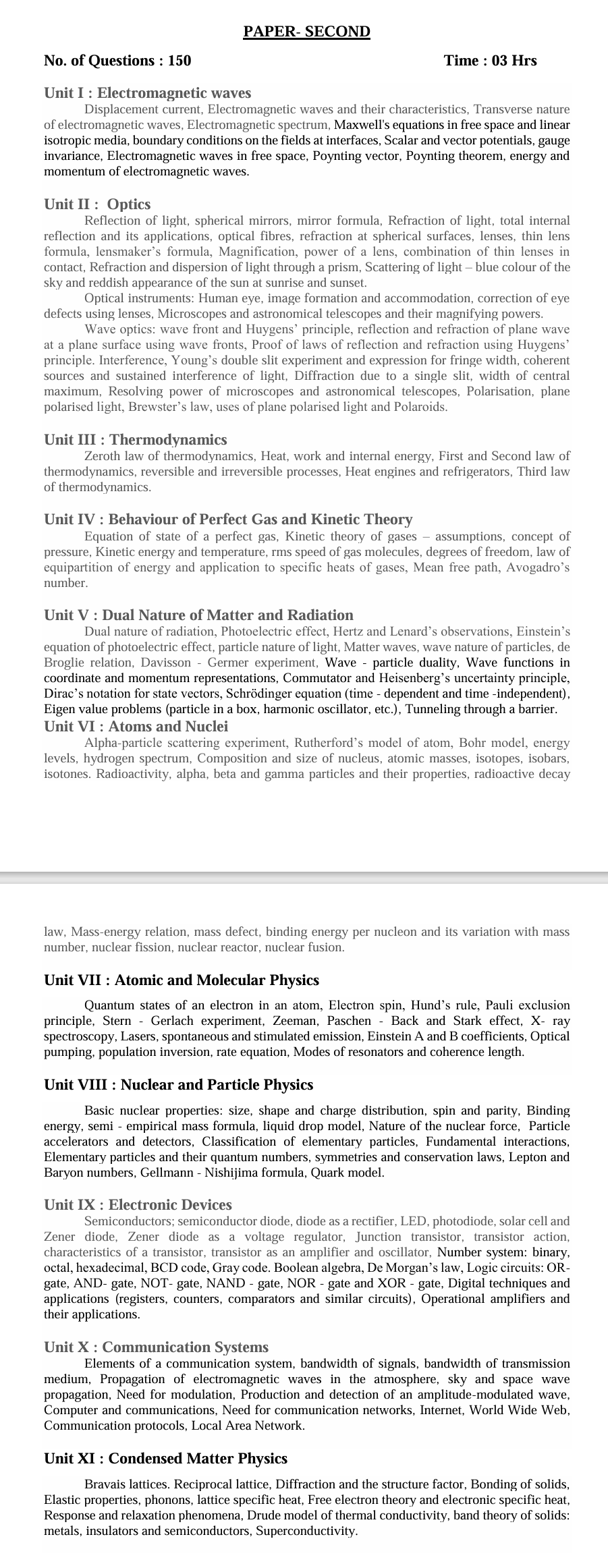
- Electromagnetic Waves
Displacement current, Maxwell’s equations in differential and integral form, transverse nature of EM waves, Poynting vector and theorem, energy and momentum transport in EM waves, electromagnetic spectrum. - Optics
- Ray Optics: Reflection and refraction at plane/curved surfaces, total internal reflection, lens maker’s formula, lens combinations, dispersion by prism, scattering of light (Rayleigh scattering – blue sky, reddish sunset), optical instruments (compound microscope, astronomical telescope).
- Wave Optics: Huygens’ principle, Young’s double-slit interference, diffraction (single slit, grating), resolving power of microscope and telescope, polarization (Brewster’s law, Malus law), lasers (basic principle).
- Thermodynamics
Zeroth, first, and second laws of thermodynamics, reversible and irreversible processes, Carnot cycle and efficiency, heat engines and refrigerators, entropy, thermodynamic potentials, third law of thermodynamics. - Behaviour of Perfect Gas and Kinetic Theory
Equation of state of ideal gas, kinetic theory assumptions, pressure of ideal gas, RMS speed, degrees of freedom, law of equipartition of energy, mean free path, Avogadro’s number, specific heats of gases. - Dual Nature of Matter and Radiation
Photoelectric effect, Einstein’s photoelectric equation, de Broglie hypothesis, Davisson-Germer experiment, Heisenberg’s uncertainty principle, time-dependent and time-independent Schrödinger equation, eigen value problems (particle in 1D box, harmonic oscillator), tunneling. - Atoms and Nuclei
Rutherford and Bohr atomic models, hydrogen spectrum (Rydberg formula), radioactivity (alpha, beta, gamma decay laws), mass-energy equivalence, binding energy per nucleon, nuclear fission and fusion reactions. - Atomic and Molecular Physics
Quantum states of electron in atom, Pauli exclusion principle, spin-orbit coupling, Stern-Gerlach experiment, Zeeman and Stark effects, lasers (spontaneous and stimulated emission, population inversion), optical pumping, Raman effect. - Nuclear and Particle Physics
Nuclear binding energy, semi-empirical mass formula, liquid drop model, shell model, particle accelerators (cyclotron, betatron), elementary particles (quarks, leptons), conservation laws (baryon, lepton number), fundamental interactions. - Electronic Devices
Semiconductors (intrinsic/extrinsic, p-n junction), diodes (rectifier, LED, photodiode, solar cell, Zener diode), transistors (BJT characteristics, amplifier, oscillator), digital electronics (binary system, Boolean algebra, logic gates: OR, AND, NOT, NAND, NOR, XOR, XNOR), flip-flops, registers, operational amplifiers (inverting/non-inverting). - Communication Systems (Limited Coverage)
Bandwidth of signals and transmission media, propagation of EM waves (ground, sky, space wave), amplitude and frequency modulation, basic elements of communication system. - Condensed Matter Physics
Crystal structure (Bravais lattices, reciprocal lattice), types of bonding in solids, phonons and lattice vibrations, specific heat of solids (Dulong-Petit, Einstein, Debye models), free electron theory, band theory of solids (metals, insulators, semiconductors), superconductivity (Meissner effect, Type I/II superconductors).
Download UKPSC Lecturer Physics Syllabus PDF Link
Preparation Tips for UKPSC Physics Lecturer 2025
- Prioritize high-weightage topics: Classical Mechanics, Electromagnetism, Quantum Mechanics, and Optics.
- Use standard books: HC Verma, Resnick-Halliday, Griffiths (Electrodynamics), Kittel (Solid State).
- Solve numerical problems daily.
- Practice Previous Year Question Papers to understand the exact pattern and difficulty level. Download and solve UKPSC Lecturer Physics PYQs here: #UKPSC Lecturer Physics Previous Year Question Papers (PYQs) Download with Solutions.
How to Download Official UKPSC Lecturer Physics Syllabus & Notification PDF 2025
- Visit the official website: psc.uk.gov.in.
- Go to “Recruitment” > “Advertisements”.
- Search for “Uttarakhand Special Subordinate Education (Lecturer Cadre ‘Group-C’) Service Exam-2025”.
- Download the full notification PDF – the detailed syllabus for Physics is in Appendix-1.
Disclaimer: This detailed breakdown is based on the official UKPSC notification released on December 30, 2025. Always cross-verify with the latest updates on the official UKPSC website. Best of luck with your preparation!


I think the admin of this web site is in fact working hard in support of his website, for the reason that here every stuff is
quality based stuff.
I agree with your details , superb post.