
Are you preparing for the UPPSC GIC Physics Lecturer 2025 exam? If yes, then you’re in the right place! The Uttar Pradesh Public Service Commission (UPPSC) conducts the Government Inter College (GIC) Lecturer recruitment for Physics and other subjects. This is a golden opportunity for postgraduate Physics candidates with B.Ed. to secure a stable government teaching job in Uttar Pradesh’s prestigious inter colleges.
In this detailed guide, we’ll cover the complete exam pattern, detailed Physics syllabus, eligibility, and tips to help you succeed. We’ve made this article comprehensive yet easy to read, just like a friendly chat over coffee.
For the official syllabus and notification PDF, always refer to the UPPSC website: uppsc.up.nic.in. You can download the latest advertisement and syllabus directly from there.
UPPSC GIC Lecturer Post Details and Salary
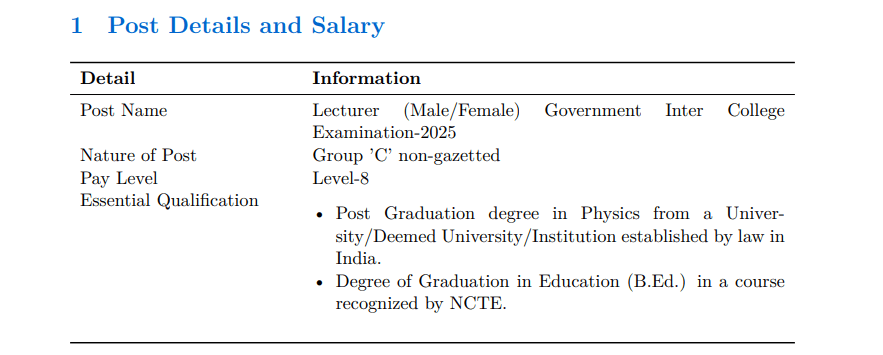
The post is for Lecturer (Physics) in Government Inter Colleges (Male/Female branches).
- Nature of Post: Group ‘C’ non-gazetted
- Pay Scale: Level-8 (as per 7th Pay Commission)
- Essential Qualification:
- Master’s degree (Post Graduation) in Physics from a recognized university.
- B.Ed. degree recognized by NCTE.
This role offers job security, respectable salary, and the joy of teaching Physics to Classes 11-12 students.
UPPSC GIC Lecturer 2025 Exam Pattern
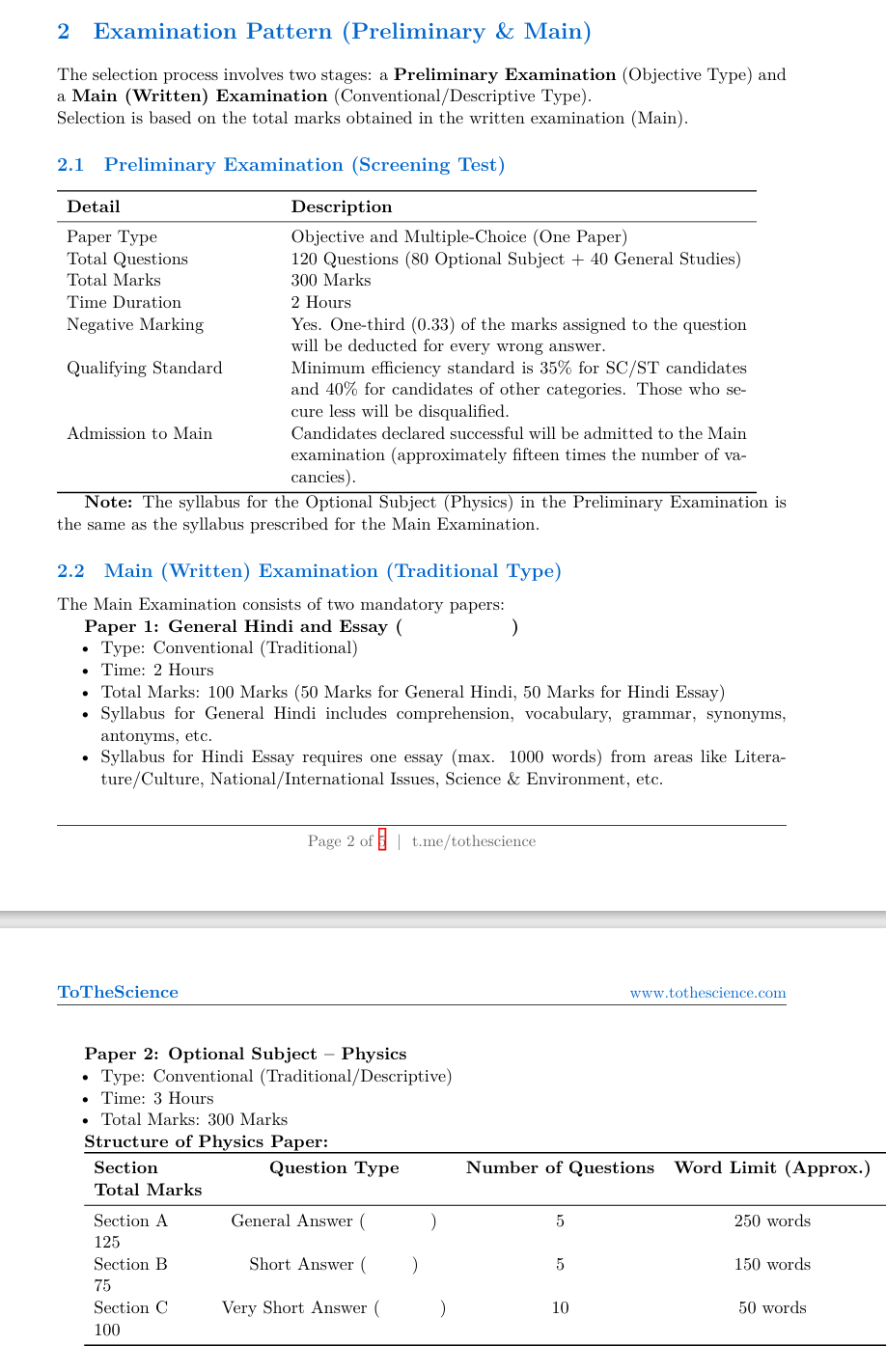
The selection process has two stages: Preliminary Exam (screening) and Main Exam (merit-based).
Preliminary Exam (Objective Type)
- One paper with 120 questions.
- 80 questions from Physics (optional subject).
- 40 questions from General Studies.
- Total Marks: 300
- Duration: 2 hours
- Negative Marking: 1/3rd mark deducted for wrong answers.
- Qualifying Marks: 40% (General), 35% (SC/ST).
About 15 times the vacancies qualify for Mains.
Note: Physics syllabus in Prelims is the same as Mains.
Main Exam (Descriptive Type)
Two compulsory papers:
Paper 1: General Hindi and Essay
- Marks: 100 (50 Hindi + 50 Essay)
- Duration: 2 hours
- Topics: Comprehension, grammar, essay on literature, culture, science, etc.
Paper 2: Physics (Optional Subject)
- Marks: 300
- Duration: 3 hours
- 20 compulsory questions in three sections:
| Section | Question Type | No. of Questions | Word Limit | Marks per Question | Total Marks |
|---|---|---|---|---|---|
| A | General Answer | 5 | 250 words | 25 | 125 |
| B | Short Answer | 5 | 150 words | 15 | 75 |
| C | Very Short Answer | 10 | 50 words | 10 | 100 |
Final merit based on Main exam marks.
Detailed UPPSC GIC Physics Lecturer Syllabus 2025
The Physics syllabus is postgraduate-level, divided into seven sections. Focus on conceptual understanding and problem-solving.
(I) MECHANICS
- Basic Concepts: Physical world and measurement, Kinematics, Laws of motion, Work energy and power, Gravitation.
- Vector Mechanics: Scalar and vector products, vector identities, background of vector calculus, concept of line, surface and volume integrals, physical meaning of gradient, divergence and curl, Gauss and Stoke’s theorems.
- Rigid Body & Central Force: Centre of mass, rotating frame of reference, Coriolis force, motion of rigid bodies, moment of inertia, theorem of parallel and perpendicular axes, movement of inertia of sphere, ring, cylinder and disc. Angular momentum, torque, central force, Kepler’s Law, motion of satellite (including geostationary satellite).
- Relativity: Galilean transformation, special theory of relativity, Michelson – Morley experiment, Lorentz transformation equations, variation of mass and length with velocity, time dilation, addition of velocities and mass-energy equivalence relation.
- Fluid Mechanics & Elasticity: Stream line and turbulent motions, Reynold’s number, Stoke’s law, Poiseulle’s formula, flow of liquid through narrow tube. Bernoulli’s formula with applications, surface tension, Stress-strain relationship, Hooke’s Law, moduli of elasticity and interrelation between them, Poisson’s ratio, elastic energy.
(II) THERMAL PHYSICS
- Thermodynamics: Concept of temperature and the zeroth law, first law of thermodynamics and internal energy, isothermal and adiabatic changes, second law of thermodynamics, Entropy, Carnot cycle and Carnot engine, absolute scale of temperature. Maxwell’s thermodynamical relations. The Clausius-Clapeyron equation, porous plug experiment and Joule Thomson effect.
- Kinetic Theory of Gases: Behaviour of ideal gas and molecular theory of gasses. Maxwell distribution law of velocities, calculation of mean velocity, root mean square velocity and the Most probable velocity. Degrees of freedom, Law of equipartition of energy, specific heats of gases, mean free path, transport phenomena.
- Radiation: Black body radiation, Stefan’s law, Newton’s law of cooling, Wien’s law, Rayleigh Jeans law, Planck’s law, solar constant.
- Cryogenics: Production of low temperatures by adiabatic demagnetization.
(III) WAVES AND OSCILLATIONS
- Oscillations: Oscillation, simple harmonic motion, stationary and progressive waves, damped harmonic-motion, forced oscillations and resonance, sharpness of resonance.
- Wave Phenomena: Wave equation, Plane and spherical waves, superposition of waves. Fourier analysis of periodic waves- square and triangular waves, phase and group velocities, Beats.
(IV) OPTICS: LASERS
- Geometrical Optics: Cardinal points of a coaxial system, simple problems on combination of thin lenses, eyepiece- Ramsden and Huygens eyepieces.
- Interference & Diffraction: Huygen’s principle, conditions for sustained interference, Young double slit experiment, division of amplitude and wavefront, Fresnel biprism, Newton’s rings, Michelson-interferometer. Diffraction by straight edge, single, double and multiple slits. Rayleigh’s criterion, resolving power of optical instruments.
- Polarization: Production and detection of polarized light (linear circular and elliptical). Brewster’s law, Huygen’s theory of double refraction, optical rotation, polarimeters.
- Lasers: Temporal and spatial coherence, stimulated emission, basic ideas about laser emission, Ruby and He-Ne lasers.
(V) ELECTRICITY AND MAGNETISM
- Electrostatics & Circuits: Gauss law and its applications, electric potential, Kirchhoff’s laws and their applications, Wheatstone’s bridge.
- Magnetostatics: Biot-Savart law, Ampere’s circuital law, and their applications. Magnetic induction and field strength, magnetic field on the axis of circular coil.
- Electromagnetism (EM) & AC Circuits: Electromagnetic induction, Faraday’s and Lenz’s law, self and mutual inductances. Alternating current, L.C.R. circuits, series and parallel resonance circuits, quality factor.
- EM Waves & Magnetism: Maxwell’s equations and electromagnetic waves, transverse nature of electromagnetic waves, Poynting vector. Dia-, para-, ferro-, antiferro- and feri-magnetism (qualitative approach only), hysteresis.
(VI) MODERN PHYSICS
- Atomic Structure & Spectra: Bohr’s theory of hydrogen atom, electron spin, Pauli’s exclusion principle, optical and X-ray spectra. Spatial quantization and Stern-Gerlach experiment, vector model of the atom, spectral terms, fine structure of spectral lines, J-J and L-S coupling, Zeeman effect, Raman effect.
- Quantum Mechanics: Photoelectric effect, Compton effect, de Broglie waves, wave-particle duality, Uncertainty principle. Postulates of quantum mechanics, Schrödinger wave equation and its applications to (i) particle in a box (ii) motion across a step potential (iii) one dimensional harmonic oscillator, and eigen values.
- Solid State Theory: Einstein’s and Debye theory of specific heat of solids. Band theory of solids, energy band, Kronig-Penny model in one dimension, energy gap, distinction between metals, semiconductors and insulators, variation of Fermi level with temperature and effective mass.
- Nuclear Physics: Radio activity, alpha, beta and gamma radiations, elementary theory of alpha decay, nuclear binding energy, Semi empirical mass formula, nuclear fission and fusion and nuclear reactors. Elementary particles, particle accelerator, cyclotron, linear accelerator. Elementary ideas of super conductivity.
(VII) ELECTRONICS
- Semiconductors and Devices: Intrinsic and extrinsic semiconductors, PN junction, Zener diode and their characteristics, unipolar and bipolar transistors, solar cells.
- Applications: Use of diode and transistor for rectification, amplification, oscillation, modulation and detection, r.f. waves.
- Digital Electronics: Logic gates and their truth tables, some applications.
This syllabus matches the official one – perfect for both Prelims and Mains Physics sections.
UPPSC (UP) GIC Physics Lecturer 2025 Exam Syllabus PDF Download
Preparation Tips for Success
- Start with NCERT (11-12) for basics, then standard UG/PG books like HC Verma, Resnick-Halliday, Griffiths.
- Practice previous year questions and mock tests.
- For Hindi/Essay: Read newspapers, practice writing.
- Time management is key in descriptive Mains.
If you’re looking for more resources like mock tests, notes, or video lectures for teaching exams, check out our site: www.tothescience.com. Join our Telegram channel for updates: t.me/tothescience.
All the best for your UPPSC GIC Physics Lecturer 2025 exam! Stay consistent, and you’ll crack it. Feel free to comment if you have doubts.
Prepared by ToTheScience – Your Partner in Science Education
www.tothescience.com | t.me/tothescience