
Hey aspiring lecturers! If you’re an MSc Physics graduate eyeing the UPPSC Polytechnic Lecturer Physics 2025 exam, you’ve landed on the perfect resource. With 24 dedicated vacancies for Physics in the latest UPPSC Technical Education (Teaching) Service recruitment (513 total posts), this is a fantastic chance to secure a gazetted government teaching job in UP polytechnics.
Candidates are buzzing with searches like “UPPSC Polytechnic Lecturer Physics syllabus 2025 PDF download”, “UP Polytechnic Physics lecturer exam pattern”, “UPPSC Polytechnic Lecturer Physics Syllabus 2025 PDF detailed topics“, and “best books for UPPSC Physics lecturer 2025”.
This comprehensive, up-to-date guide covers the full syllabus breakdown, exam pattern, marking scheme, high-weightage topics, book recommendations, and smart tips – all to help you prepare effectively and crack the exam.
Quick Overview: UPPSC Polytechnic Lecturer Physics Exam 2025
The exam is objective-type with negative marking, focusing on diploma-level Physics teaching aptitude. It’s divided into two papers, testing foundational and advanced concepts.
Official Notification & Syllabus PDF: Download from UPPSC Official Website – check under “Notifications/Advertisements” for Advt. No. A-11/E-1/2025.
UPPSC Polytechnic Lecturer Physics Exam Pattern 2025
The written exam is the main stage (750 marks), followed by interview (100 marks). Here’s the detailed pattern:
| Paper | Sections | Questions | Marks per Question | Total Marks | Duration | Negative Marking |
|---|---|---|---|---|---|---|
| Paper-I | General Hindi (25 Q) + Physics Paper-I (100 Q) | 125 | 3 | 375 | 2.5 hours | -1 per wrong |
| Paper-II | General Studies (25 Q) + Physics Paper-II (100 Q) | 125 | 3 | 375 | 2.5 hours | -1 per wrong |
Total Written Marks: 750
Key Notes:
- OMR-based MCQs.
- Negative marking: 1 mark deducted for each incorrect answer (accuracy is crucial!).
- Focus 80% on Physics sections (200 questions total).
- General Hindi & GS are qualifying but contribute to score.
Selection: Written merit + Interview performance.
For full recruitment details, read our main guide: UPPSC Polytechnic Lecturer Physics Recruitment 2025: 24 Vacancies & Salary Guide
Detailed UPPSC Polytechnic Lecturer Physics Syllabus 2025
The UPPSC Polytechnic Lecturer Physics Syllabus is split into Paper-I (foundational topics) and Paper-II (advanced/applied). It’s UG/PG level but tailored for diploma teaching – emphasis on concepts, numericals, derivations, and practical applications.
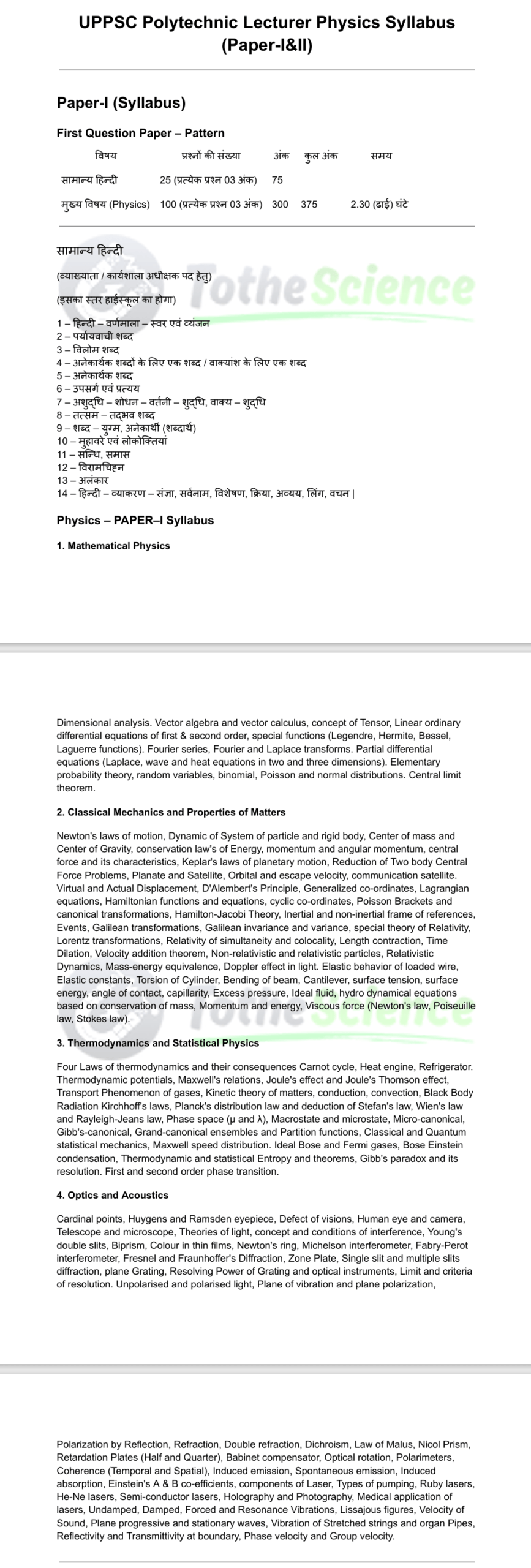
UPPSC Polytechnic Lecturer Physics Paper-I Syllabus: Core & Foundational
UPPSC Polytechnic Lecturer Physics Syllabus is split into Part-I (General Hindi) and Part-II (Physics-I).
Part-1: सामान्य हिन्दी
(इसका स्तर हाईस्कूल का होगा)
1 – हिन्दी – वर्णमाला – स्वर एवं व्यंजन
2 – पर्यायवाची शब्द
3 – विलोम शब्द
4 – अनेकार्थक शब्दों के लिए एक शब्द / वाक्यांश के लिए एक शब्द
5 – अनेकार्थक शब्द
6 – उपसर्ग एवं प्रत्यय
7 – अशुद्धि – शोधन – वर्तनी – शुद्धि, वाक्य – शुद्धि
8 – तत्सम – तद्भव शब्द
9 – शब्द – युग्म, अनेकार्थी (शब्दार्थ)
10 – मुहावरे एवं लोकोक्तियां
11 – सन्धि, समास
12 – विरामचिह्न
13 – अलंकार
14 – हिन्दी – व्याकरण – संज्ञा, सर्वनाम, विशेषण, क्रिया, अव्यय, लिंग, वचन |
Part-2: Physics Paper-I Syllabus (Core & Foundational Physics)
1. Mathematical Physics
Dimensional analysis. Vector algebra and vector calculus, concept of Tensor, Linear ordinary differential equations of first & second order, special functions (Legendre, Hermite, Bessel, Laguerre functions). Fourier series, Fourier and Laplace transforms. Partial differential equations (Laplace, wave and heat equations in two and three dimensions). Elementary probability theory, random variables, binomial, Poisson and normal distributions. Central limit theorem.
2. Classical Mechanics and Properties of Matters
Newton’s laws of motion, Dynamic of System of particle and rigid body, Center of mass and Center of Gravity, conservation law’s of Energy, momentum and angular momentum, central force and its characteristics, Keplar’s laws of planetary motion, Reduction of Two body Central Force Problems, Planate and Satellite, Orbital and escape velocity, communication satellite. Virtual and Actual Displacement, D’Alembert’s Principle, Generalized co-ordinates, Lagrangian equations, Hamiltonian functions and equations, cyclic co-ordinates, Poisson Brackets and canonical transformations, Hamilton-Jacobi Theory, Inertial and non-inertial frame of references, Events, Galilean transformations, Galilean invariance and variance, special theory of Relativity, Lorentz transformations, Relativity of simultaneity and colocality, Length contraction, Time Dilation, Velocity addition theorem, Non-relativistic and relativistic particles, Relativistic Dynamics, Mass-energy equivalence, Doppler effect in light. Elastic behavior of loaded wire, Elastic constants, Torsion of Cylinder, Bending of beam, Cantilever, surface tension, surface energy, angle of contact, capillarity, Excess pressure, Ideal fluid, hydro dynamical equations based on conservation of mass, Momentum and energy, Viscous force (Newton’s law, Poiseuille law, Stokes law).
3. Thermodynamics and Statistical Physics
Four Laws of thermodynamics and their consequences Carnot cycle, Heat engine, Refrigerator. Thermodynamic potentials, Maxwell’s relations, Joule’s effect and Joule’s Thomson effect, Transport Phenomenon of gases, Kinetic theory of matters, conduction, convection, Black Body Radiation Kirchhoff’s laws, Planck’s distribution law and deduction of Stefan’s law, Wien’s law and Rayleigh-Jeans law, Phase space (μ and λ), Macrostate and microstate, Micro-canonical, Gibb’s-canonical, Grand-canonical ensembles and Partition functions, Classical and Quantum statistical mechanics, Maxwell speed distribution. Ideal Bose and Fermi gases, Bose Einstein condensation, Thermodynamic and statistical Entropy and theorems, Gibb’s paradox and its resolution. First and second order phase transition.
4. Optics and Acoustics
Cardinal points, Huygens and Ramsden eyepiece, Defect of visions, Human eye and camera, Telescope and microscope, Theories of light, concept and conditions of interference, Young’s double slits, Biprism, Colour in thin films, Newton’s ring, Michelson interferometer, Fabry-Perot interferometer, Fresnel and Fraunhoffer’s Diffraction, Zone Plate, Single slit and multiple slits diffraction, plane Grating, Resolving Power of Grating and optical instruments, Limit and criteria of resolution. Unpolarised and polarised light, Plane of vibration and plane polarization, Polarization by Reflection, Refraction, Double refraction, Dichroism, Law of Malus, Nicol Prism, Retardation Plates (Half and Quarter), Babinet compensator, Optical rotation, Polarimeters, Coherence (Temporal and Spatial), Induced emission, Spontaneous emission, Induced absorption, Einstein’s A & B co-efficients, components of Laser, Types of pumping, Ruby lasers, He-Ne lasers, Semi-conductor lasers, Holography and Photography, Medical application of lasers, Undamped, Damped, Forced and Resonance Vibrations, Lissajous figures, Velocity of Sound, Plane progressive and stationary waves, Vibration of Stretched strings and organ Pipes, Reflectivity and Transmittivity at boundary, Phase velocity and Group velocity.
High-Weightage in Paper-I: Mathematical Physics & Classical Mechanics – lots of numericals!
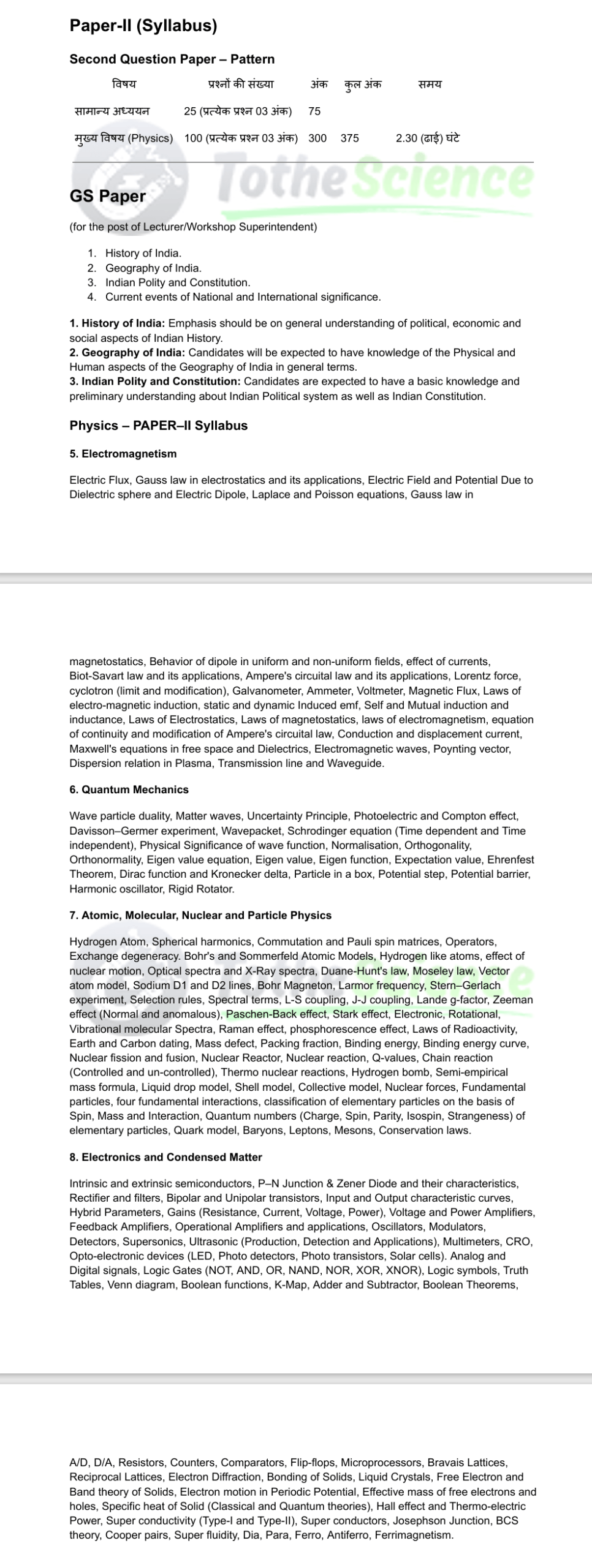
Paper-II Syllabus: Advanced
UPPSC Polytechnic Lecturer Physics Syllabus Paper-II Also Divided into two parts:
Part-1: GS Paper (25 MCQs)
- History of India.
- Geography of India.
- Indian Polity and Constitution.
- Current events of National and International significance.
1. History of India: Emphasis should be on general understanding of political, economic and social aspects of Indian History.
2. Geography of India: Candidates will be expected to have knowledge of the Physical and Human aspects of the Geography of India in general terms.
3. Indian Polity and Constitution: Candidates are expected to have a basic knowledge and preliminary understanding about Indian Political system as well as Indian Constitution.
Part-2: Physics-II Syllabus (100 MCQs)
5. Electromagnetism
Electric Flux, Gauss law in electrostatics and its applications, Electric Field and Potential Due to Dielectric sphere and Electric Dipole, Laplace and Poisson equations, Gauss law in magnetostatics, Behavior of dipole in uniform and non-uniform fields, effect of currents, Biot-Savart law and its applications, Ampere’s circuital law and its applications, Lorentz force, cyclotron (limit and modification), Galvanometer, Ammeter, Voltmeter, Magnetic Flux, Laws of electro-magnetic induction, static and dynamic Induced emf, Self and Mutual induction and inductance, Laws of Electrostatics, Laws of magnetostatics, laws of electromagnetism, equation of continuity and modification of Ampere’s circuital law, Conduction and displacement current, Maxwell’s equations in free space and Dielectrics, Electromagnetic waves, Poynting vector, Dispersion relation in Plasma, Transmission line and Waveguide.
6. Quantum Mechanics
Wave particle duality, Matter waves, Uncertainty Principle, Photoelectric and Compton effect, Davisson–Germer experiment, Wavepacket, Schrodinger equation (Time dependent and Time independent), Physical Significance of wave function, Normalisation, Orthogonality, Orthonormality, Eigen value equation, Eigen value, Eigen function, Expectation value, Ehrenfest Theorem, Dirac function and Kronecker delta, Particle in a box, Potential step, Potential barrier, Harmonic oscillator, Rigid Rotator.
7. Atomic, Molecular, Nuclear and Particle Physics
Hydrogen Atom, Spherical harmonics, Commutation and Pauli spin matrices, Operators, Exchange degeneracy. Bohr’s and Sommerfeld Atomic Models, Hydrogen like atoms, effect of nuclear motion, Optical spectra and X-Ray spectra, Duane-Hunt’s law, Moseley law, Vector atom model, Sodium D1 and D2 lines, Bohr Magneton, Larmor frequency, Stern–Gerlach experiment, Selection rules, Spectral terms, L-S coupling, J-J coupling, Lande g-factor, Zeeman effect (Normal and anomalous), Paschen-Back effect, Stark effect, Electronic, Rotational, Vibrational molecular Spectra, Raman effect, phosphorescence effect, Laws of Radioactivity, Earth and Carbon dating, Mass defect, Packing fraction, Binding energy, Binding energy curve, Nuclear fission and fusion, Nuclear Reactor, Nuclear reaction, Q-values, Chain reaction (Controlled and un-controlled), Thermo nuclear reactions, Hydrogen bomb, Semi-empirical mass formula, Liquid drop model, Shell model, Collective model, Nuclear forces, Fundamental particles, four fundamental interactions, classification of elementary particles on the basis of Spin, Mass and Interaction, Quantum numbers (Charge, Spin, Parity, Isospin, Strangeness) of elementary particles, Quark model, Baryons, Leptons, Mesons, Conservation laws.
8. Electronics and Condensed Matter
Intrinsic and extrinsic semiconductors, P–N Junction & Zener Diode and their characteristics, Rectifier and filters, Bipolar and Unipolar transistors, Input and Output characteristic curves, Hybrid Parameters, Gains (Resistance, Current, Voltage, Power), Voltage and Power Amplifiers, Feedback Amplifiers, Operational Amplifiers and applications, Oscillators, Modulators, Detectors, Supersonics, Ultrasonic (Production, Detection and Applications), Multimeters, CRO, Opto-electronic devices (LED, Photo detectors, Photo transistors, Solar cells). Analog and Digital signals, Logic Gates (NOT, AND, OR, NAND, NOR, XOR, XNOR), Logic symbols, Truth Tables, Venn diagram, Boolean functions, K-Map, Adder and Subtractor, Boolean Theorems, A/D, D/A, Resistors, Counters, Comparators, Flip-flops, Microprocessors, Bravais Lattices, Reciprocal Lattices, Electron Diffraction, Bonding of Solids, Liquid Crystals, Free Electron and Band theory of Solids, Electron motion in Periodic Potential, Effective mass of free electrons and holes, Specific heat of Solid (Classical and Quantum theories), Hall effect and Thermo-electric Power, Super conductivity (Type-I and Type-II), Super conductors, Josephson Junction, BCS theory, Cooper pairs, Super fluidity, Dia, Para, Ferro, Antiferro, Ferrimagnetism.
High-Weightage in Paper-II: Electromagnetism & Electronics – application-based questions common.
General Hindi (Paper-I): Basic grammar, comprehension, idioms (elementary level).
General Studies (Paper-II): Current affairs, Indian history/geography/polity, basic science.
Complete UPPSC Polytechnic Lecturer Physics Syllabus PDF Download Here
Best Books for UPPSC Polytechnic Lecturer Physics Preparation
- Mathematical Physics: H.K. Dass or Arfken.
- Classical Mechanics: J.C. Upadhyaya or Goldstein (basics).
- Thermodynamics: Garg, Bansal & Sarkar.
- Optics: Ajoy Ghatak or Brijlal.
- Electromagnetism: David J. Griffiths or Reitz & Milford.
- Quantum Mechanics: Satya Prakash or Nouredine Zettili.
- Nuclear/Atomic: S.B. Patil.
- Electronics: Millman & Halkias or Boylestad.
- General Hindi: Lucent or Hardev Bahri.
- GS: Lucent General Knowledge.
Practice from previous UPPSC papers and polytechnic-level objective books.
Preparation Tips to Score High
- Prioritize Accuracy: With -1 negative, aim for 80-90% correct attempts.
- Time Management: Practice 120 questions in 2 hours per paper.
- Focus Areas: Numericals (mechanics, EM), derivations (quantum, thermo), diagrams (optics, electronics).
- Daily Plan: 4 hours subject revision + 2 hours practice + 1 hour Hindi/GS.
- PYQs: Solve the UPPSC Polytechnic Lecturer Physics Previous Years Questions
- Mocks: Take weekly full tests – analyze weak topics.
- Revision: Make formula sheets and short notes.
For vacancy, salary, and eligibility details: UPPSC Polytechnic Lecturer Physics 2025 Full Guide
FAQs: UPPSC Polytechnic Lecturer Physics 2025
Q: Where to download official syllabus PDF?
A: From UPPSC website notifications section.
Q: Is negative marking there?
A: Yes, -1 per wrong answer.
Q: How many questions from Physics?
A: 200 total (100 each paper).
Q: Best strategy for non-engineering MSc holders?
A: Focus on conceptual clarity and diploma-level applications.
This is your complete roadmap – bookmark it! If it helped, share with friends. Need PYQs or mocks? Comment below. All the best – ace that exam and become a government lecturer! 💪