
RPSC 2nd Grade Science Syllabus 2026 is the key document for candidates aspiring to become Senior Teachers in Rajasthan’s government schools. Released by the Rajasthan Public Service Commission (RPSC), this syllabus outlines everything you need to prepare for the Science subject in the Senior Teacher (Grade II) exam.
In this article, we provide a detailed breakdown of Paper 1 and Paper 2, exam pattern, eligibility, preparation tips, and official PDF download links.
Quick Info: RPSC 2nd Grade Teacher (Science) 2026
RPSC has announced over 6500 vacancies for Senior Teacher (Grade II) posts across various subjects, including Science. This is a golden opportunity for a permanent teaching job in Rajasthan’s secondary education department.
| Details | Information |
|---|---|
| Exam Name | RPSC Senior Teacher Grade II (Science) 2026 |
| Total Vacancies | 6500+ (including Science and other subjects) |
| Exam Date | 12 to 18 July 2026 (multiple shifts) (Announced) |
| Official Website | rpsc.rajasthan.gov.in |
RPSC 2nd Grade Science Eligibility Criteria
To apply for RPSC 2nd Grade Science:
- Educational Qualification: Graduation from a UGC-recognized university (with at least two subjects from Physics, Chemistry, and Biology as optional) + B.Ed./D.El.Ed. or equivalent.
- Age Limit: 18 to 40 years (relaxation for reserved categories).
- Other: Knowledge of Rajasthani culture is essential (tested in Paper 1).
RPSC 2nd Grade Science Exam Pattern
RPSC 2nd Grade Science exam consists of two papers:
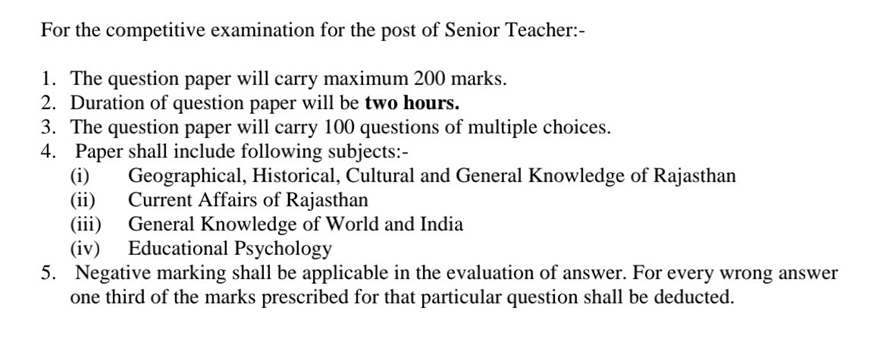
- Paper 1: 200 marks, 100 questions, 2 hours (General Knowledge + Educational Psychology).
- Paper 2: 300 marks, 150 questions, 2.5 hours (Science subject knowledge + Teaching Methods).
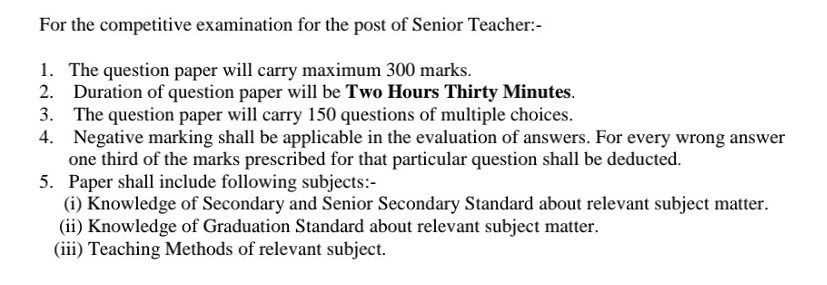
- Negative Marking: 1/3 mark deducted for each wrong answer.
RPSC 2nd Grade Science Syllabus Topic Wise
We already discussed about exam pattern in above paragraph is that the RPSC 2nd Grade Science Syllabus consist two papers:
- Paper-1 (GK) : RPSC 2nd Grade common paper for all subjects
- Paper-2 (Main Subjects + Teaching Aptitudes): RPSC 2nd Grade Science Syllabus/RPSC TGT Science Syllabus
RPSC 2nd Grade Science Syllabus Paper 1-GK (Common for All Subjects)
RPSC 2nd Grade paper-1 (GK) covers General Knowledge and Educational Psychology.
| Unit | Main Topics |
|---|---|
| Geographical, Historical, Cultural & GK of Rajasthan | Geography, History (ancient civilizations, dynasties, freedom struggle), folk deities, fairs, festivals, political system |
| Current Affairs of Rajasthan | State-level socio-economic, political, and sports events |
| General Knowledge of World & India | Continents, oceans, Indian economy, Constitution, foreign policy |
| Educational Psychology | Learning theories, personality, intelligence, motivation, individual differences |
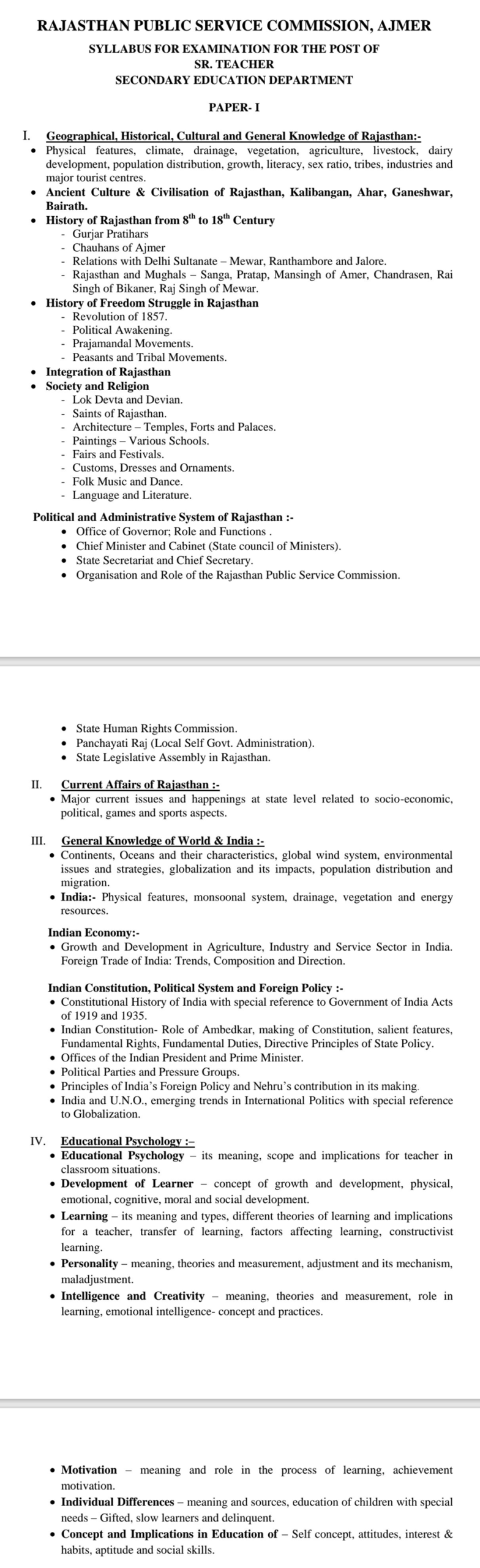
Download: RPSC 2nd Grade Paper 1 Syllabus PDF (GK_Common Paper)
RPSC 2nd Grade Science Syllabus (Paper 2: Main Subjects)
RPSC 2nd Grade Science Syllabus (Paper 2) includes three sections: Secondary/Senior Secondary level, Graduation level, and Teaching Methods.
1. Secondary and Senior Secondary Standard
- Cell and Molecular Biology: Structure and functions of cell and cell organelles, Nucleic acids, DNA and RNA; Central dogma; Structure and functions of Proteins, Carbohydrates and Lipids.
- Genetics: Mendelian work and Mendelism; Blood groups, Rh factor and Genetic disorders.
- Taxonomy: Five Kingdom System; classification and characteristics of major phylums of Animal Kingdom (Protozoa to Chordata) and Plant groups (Algae to Angiosperms).
- Ecology and Environmental Biology: Food chain, food web and ecological pyramids; Pollution (air, water, soil and noise); Wildlife and its conservation; endangered species; Sanctuaries and National parks with special reference to the state of Rajasthan.
- Biotechnology: Recombinant DNA technology – Tools and techniques; gene cloning, cloning vectors, DNA amplification, Polymerase Chain Reaction.
- Microbiology: Eukaryota, Prokaryota; Viruses, Bacteria, Mycoplasma, Lichens.
- Plant Morphology and Anatomy: Types of Plant tissues, Histological organisation of monocot and dicot root, stem and leaves; Structure of flower; Types of inflorescence.
- Water Relation: Water as a biomolecule – physical and chemical properties; Osmosis DPD, Plasmolysis, Water potential, Absorption of water, Ascent of sap.
- Photosynthesis and Respiration: Photosynthetic pigments; Photo systems; Red drop phenomenon; Emmerson effect; Light reaction, Dark reaction (C3 cycle); Bacterial photosynthesis and Chemosynthesis; Factors affecting photosynthesis. Respiration: Types of respiration; Glycolysis, Kreb cycle; Respiratory quotient; Fermentation.
- Enzymes: Structure, Classification, Mechanism of Action and Factors affecting enzyme activities.
- Plant Growth and Development: Differentiation, Dedifferentiation and Redifferentiation. Structure Discovery and Roles of Plant Growth Regulators – Auxin, Gibbrellins, Cytokinins, Ethylene and Abscisic acid.
- Animal Developmental Biology: Gametogenesis, Fertilization, Cleavage, Gastrulation, Organogenesis.
- Evolution: Lamarkism, Darwinism, Natural selection, Adaptation, Neo-Darwinism, Neo-Lamarkism; Concept of species and speciation.
- Human Anatomy and Physiology: Structure and function of human tissue, digestive system, excretory system, respiratory system, circulatory system and nervous system.
- Human Health: Nutrition, common human diseases, vaccination, immunity, tissue and organ transplantations and Bio-treatment techniques.
- Atomic Structure: Fundamental Particles, Atomic models and their limitations, dual nature of particles, de-broglie equation, uncertainty principle, Modern concept of atomic structure, quantum numbers, Aufbau principle, Pauli’s exclusion principle, Hund’s rule, (n+l) rule. Electronic configuration of elements. Atomic mass, molecular mass, Equivalent mass, Mole concept, Symbols, ions, radicals, variable valancies, type of formulas – empirical formula, molecular formula, Chemical stoichiometry.
- Chemical Bonding and Molecular Structure: Ionic bond, covalent bond, coordinate bond. General properties of ionic and covalent bond, polarization, hybridization, Geometry of molecules, directional properties of bond, Fajan’s Rule, concept of resonance.
- Classification of Elements and Periodicity in Properties: Mendeleev’s periodic law and classification of elements, limitation of Mendeleev’s periodic table, Modern concept of periodic table, electronic configuration and nomenclature of elements, Periodicity in properties – atomic and ionic radii, ionisation enthalpy, electron gain enthalpy, electro negativity and valency.
- Equilibrium: Law of mass action and its application to homogeneous equilibria, Le-chatelier principle and its application to physical and chemical system. Factors affecting chemical equilibria. Ionic equilibria in solutions, Acid-base concept, pH scale, Buffer solution. Dissociation of acid and base, Common ion effect and its importance. Solubility product and its uses.
- Redox Reactions: Concept of redox reactions, Oxidation numbers, balancing and applications of redox reactions.
- Organic Chemistry: Different methods of purification, qualitative and quantitative analysis, classification and IUPAC nomenclature of organic compounds. Homolytic and heterolytic bond fission, free radicals, carbocations, carbanions, electrophiles and nucleophiles, type of organic reactions.
- Hydrocarbons: Aliphatic hydrocarbons (Alkane, Alkene and Alkyne); Aromatic hydrocarbon (Benzene), concept of aromaticity, chemical properties.
- Physical World and Measurements: Fundamental and derived units, systems of units, dimensional formula and dimensional equations, accuracy, and error in measurements.
- Vectors: Concept of vector quantity and vector, unit vector, vector addition and multiplication.
- Kinematics: Motion in one dimension, uniformly accelerated motion, motion with uniform velocity, relative velocity.
- Laws of Motion: Newton’s laws of motion, impulse, momentum, conservation of momentum.
- Work, Energy, Power: Work done by a constant/variable force, Kinetic and potential energy, conservative/non-conservative forces, power.
- Rotational Motion: Angular momentum, torque, centripetal & centrifugal force, moment of inertia, rolling motion.
- Friction: Origin of friction, quantifying frictional forces, types of friction.
- Gravitation: Universal laws of gravitation, gravitational acceleration (g), variation of g, orbital velocity, escape velocity, planetary motion, Kepler’s law.
- Properties of Matter: Hook’s law, young’s modulus, bulk modulus, tortional rigidity, Application of elastic behaviour.
- Fluid dynamics: Types of flow of liquid, critical velocity, coefficient of viscosity, terminal velocity, Stoke’s law, Reynold’s number, Bernoulli’s theorem, and applications.
- Electricity and Magnetism: Current Electricity, Magnetic Effect of Current and Electromagnetic Induction.
- Ray Optics: Laws of reflection and refraction, Image formation by lenses and mirrors, total internal reflection, dispersion by prism, scattering of light, defects in vision, microscope, telescope.
2. Graduation Standard
- Cell and Molecular Biology: Cell cycle, mitosis, meiosis and their significance. Chromatin organisation. DNA replication; Transcription; Translation.
- Genetics: Post Mendelian work, gene interaction, regulation of gene expression in prokaryotes and eukaryotes, linkage, crossing-over, physical mapping, sex determination and sex linked inheritance, maternal inheritance. Mutations and chromosomal aberrations.
- Animal Taxonomy: Methods of taxonomic collections; Classification and characteristics of animal kingdom up to class level.
- Representative Animals: Life cycle, external and internal features of Paramecium, Fasciola, Earthworm, Cockroach and Frog.
- Taxonomy of Angiosperms: Classification of Angiosperms; Types of inflorescence; Economic importance and Characteristic features of families – Euphorbiaceae, Solanaceae, Malvaceae, Convolvulaceae, Fabaceae, Asteraceae and Poaceae. Floral formula and floral diagram.
- Ecology and Environmental Biology: Structure and functions of ecosystem; Ecological succession; Energy flow; Biogeochemical cycles – Carbon, Nitrogen, Oxygen, Phosphorus; Major biomes of the world. Red Data Book. Environmental laws; Major environmental issues – Global warming, Greenhouse effect, Acid rain, El-Nino and La-nina, Ozone depletion, Deforestation, Carbon emission, Radiation hazards.
- Biotechnology: Genetic engineering, Gene transfer techniques; genomic library; plant and animal tissue culture; Genetically Modified crops. Application of biotechnology in agriculture and medicine; Transgenic animals and plants. DNA finger printing. Ethical issues; Biopiracy.
- Cryptogams: General characteristics, Classification, Reproduction and Types of life cycles of Algae, Fungi, Bryophytes and Pteridophytes.
- Seed Plants: General characteristics, evolution of seed habit. Classification, general character and Reproduction in Gymnosperms.
- Plant Anatomy: Apical Meristem, abnormal histological organisation of stem – medullary and cortical vascular bundles, abnormal secondary growth in stems.
- Reproduction in Plants: Double fertilization, types of embryos and endosperms, polyembryony, apomixes, parthenocarpy.
- Water Relations: Transpiration, Guttation, mechanism of stomatal movement, factors affecting transpiration, mechanism of phloem transport.
- Plant Nutrition: Macro and Micro Nutrients – their role and deficiency symptoms.
- Photosynthesis and Respiration: C3, C4 cycle and Crassulacean Acid Metabolism. Photophosphorylation – chemiosmotic hypothesis. Photorespiration. Respiration: Electron Transport Chain and Oxidative phosphorylation.
- Plant Growth and Development: Kinetics of growth, photoperiodism, vernalisation, seed dormancy, senescence, Physiology of flowering and fruit development.
- Animal Developmental Biology: Extra embryonic membranes, placenta, regeneration, stem cells, teratology, animal cloning, test tube baby, fate maps, parthenogenesis, aging, paedogenesis and neoteny.
- Human Physiology: Endocrine system, digestive glands, nerve impulse conduction, muscles contraction, hormonal control of reproduction, gas transport of oxygen and carbon dioxide in blood, cardiac cycle, blood clotting.
- Economic Zoology: Economic importance of Protozoa, Annelids, Insects and Mollusca; Social life of bees and monkeys.
- Co-ordination Compounds: Co-ordination number, Ligands and their types and Werner’s theory, IUPAC nomenclature of co-ordination compounds and formulation of mono nuclear co-ordination compound, Isomerism, shapes, colors, magnetic properties in complexes, stability of co-ordination compounds, metal carbonyl compound (classification, preparation, bonding and properties).
- Molecular Structure: Elementary idea about Valence Bond Theory, Molecular Orbital Theory (for simple homo-nuclear diatomic molecules), Valence Shell Electrons Pair Repulsion Theory, Crystal Field Theory.
- States of Matter: Gaseous state- gas laws, ideal gas equation, Dalton’s law of partial pressure, kinetic theory of gases, deviation from ideal behavior, critical temperature and its importance, liquification of gases. Liquid state- properties of liquid, vapour pressure, surface tension and viscosity coefficient and its application. Solid state- classification of solids, crystal structure.
- Zero group elements: Position in periodic table, isolation, compounds of zero group elements.
- s and p-block elements: Electronic configuration, general characteristics and properties.
- d-block elements: Electronic configuration, general characteristics for e.g. color, oxidation state, tendency to form complexes, magnetic properties, interstitial compound, catalytic properties, alloys.
- f-block elements: Lanthanides and Actinides, Electronic configuration, Lanthanide contraction and its consequences, Super heavy elements.
- Metals and Metallurgy: Minerals and ores, General principles of metallurgy, Metallurgy of Cu, Fe, Al and Zn.
- Non-metals and their Compounds: Carbon, Nitrogen, Sulphur, Oxygen, Phosphorous, halogens, Allotropes of C, S and P and their uses. Cement and Plaster of Paris.
- Chemical Kinetics: Order and molecularity of reactions, first and second order reactions and their rate expressions (no derivation), Zero and Pseudo order reactions, Arrhenius equation, Collision theory and Activated Complex Theory.
- Solutions: Osmotic pressure, lowering of vapour pressure, depression of freezing point and elevation of boiling point. Determination of molecular weight in solution. Association and dissociation of solutes.
- Electrochemistry: Electrochemical cells, electrode potentials, measurement of e.m.f. Conductance: Cell constant, specific and equivalent conductivity, Kohlrausch’s Law and its applications, solubility and solubility product, equivalent conductivity at infinite dilution of weak electrolytes, hydrolysis and hydrolysis constant.
- Surface Chemistry: Adsorption, homogenous and heterogeneous catalysis, colloids and suspensions.
- Reaction Mechanism: Inductive, Mesomeric and Hyper-conjugation, Addition and substitution, Electrophilic addition and substitution reaction, Nucleophilic addition and substitution reactions (SN1 and SN2), Elimination reactions. Directive influence of functional group.
- Spectroscopy Techniques: UV-Visible (Lambert-Beer’s law, Auxochrome and Chromophore, various shifts, calculation of λmax values of dienes, polyenes and enone compounds). IR (Molecular vibrations, Hook’s law, intensity and position of IR bands, finger print region, characteristic absorption of common functional groups).
- Bio-Inorganic Chemistry: Role of bulk and trace metal ions in biological system with special reference to Mg, Ca, Fe and Cu.
- Bio-molecules: Carbohydrates, Proteins, Vitamins, Nucleic Acids.
- Polymers: Natural and synthetic polymers.
- Chemistry in Everyday Life: Chemical in medicines, Chemicals in food, cleansing agents.
- Mechanics: Conservation laws, Centre of mass, elastic and inelastic collision, damped & forced oscillations.
- Classical Electrodynamics: Coulomb’s law, electric field and potential, dipole, dielectric, Gauss’s theorem and application, Maxwell’s equations.
- Wave Optics: Huygen’s principle, Interference of light, double slit experiment, diffraction of light, single slit diffraction, resolving power of an optical instrument, polarization and scattering of light.
- Thermal and Statistical Physics: Laws of thermodynamics, Carnot’s engine and efficiency; Internal energy, entropy, enthalpy and Gibb’s free energy and Legendre transformation. Statistical description of system of particles: ensemble, basic postulates, and density of states.
- Quantum Mechanics: Postulates of quantum mechanics, uncertainty principle, Schrodinger equation, harmonic oscillator and its stationary state, one dimensional wells and barriers. Linear vector spaces and Operators.
- Modern Physics: Special theory of relativity, nuclear physics and radioactivity, Structure of atom, wave property of matter, particle physics.
3. Teaching Methods
- Definition and concept of science, nature of science, types of correlation in context of relationship with other school subjects, aims and objectives of science teaching, Scientific method, Scientific literacy, Scientific attitude.
- Principles of developing science curriculum at secondary level, factors affecting the selection and organisation of science curriculum, National Curriculum Framework – 2005 with reference to Science, Unit plan and lesson plan, Taxonomy of educational objectives.
- Methods and approaches – Lecture cum demonstration method, laboratory method, problem solving method, project method, heuristic method, inductive and deductive method, inquiry approach, constructivist approach, multi-sensory teaching aids.
- Science laboratory and its importance, Co-curricular activities- science-club, science quiz, science fair and field trip.
- Evaluation- Concept, type and purposes, types of test items, preparation of blue print.
Download: RPSC 2nd Grade Science Syllabus PDF Paper-2 (Official syllabus from RPSC website)
RPSC 2nd Grade Science Preparation Tips
The RPSC 2nd Grade Science paper is of high standard — questions go deep into graduation-level concepts. To succeed:
- Divide the syllabus topic-wise: Complete Secondary level first, then move to Graduation.
- Use standard books: NCERT (Class 6-12), Trueman (Biology), Pradeep (Chemistry), HC Verma (Physics), and Lucent for Rajasthan GK.
- Practice 50-100 MCQs daily. Solve our [RPSC 2nd Grade Science Previous Year Paper with Solution PDF](https://tothe science.com/rpsc-2nd-grade-science-previous-year-paper-with-solution-pdf) — these help understand the pattern best.
- Stay updated with Rajasthan Current Affairs via newspapers and GK books.
- Join mock test series and focus on time management due to negative marking.
FAQs
- Where to download RPSC 2nd Grade Science Syllabus 2026 PDF?
Download from the official RPSC website or the links provided here. - Is RPSC 2nd Grade Science Previous Year Paper with Solution PDF available for free?
Yes, free download available on tothe science.com. - When is the RPSC 2nd Grade Teacher Science 2026 exam date?
Scheduled from 12 to 18 July 2026 in multiple shifts. - How many vacancies are there in RPSC 2nd Grade Science 2026?
Over 6500 total vacancies, with a good share for Science subject. - What is the expected cut off for RPSC 2nd Grade Science?
Generally 200-220 for General category in Paper 2 (varies yearly). - Which are the best books for RPSC 2nd Grade Science?
Biology – Trueman, Chemistry – Pradeep, Physics – HC Verma + Rajasthan-specific publications like Lakshya/Ray. - Is there negative marking in RPSC 2nd Grade Science exam?
Yes, 1/3 mark deducted for every wrong answer.
Conclusion
Mastering the RPSC 2nd Grade Science Syllabus 2026 with smart preparation and consistent practice can secure your government teaching job. Start early, focus on PYQs, and revise regularly. At here, you’ll find syllabus PDFs, notes, previous papers, and mock tests to support your journey. Best of luck — your success as a Senior Teacher is within reach! 🚀